






Introduction: Beyond the Women’s Health Association
When most people hear “Kegel exercises,” they instinctively think of women’s health—pregnancy recovery, postpartum healing, and feminine wellness. This association, while accurate, tells only half the story. The pelvic floor, that sling of muscles stretching from the pubic bone to the tailbone, belongs to everyone. And for men, neglecting this foundational musculature carries consequences that affect nearly every aspect of quality of life.
Kegel exercises for men remain surprisingly underdiscussed. Men who experience urinary leakage often accept it as an inevitable consequence of aging. Those grappling with erectile dysfunction explore pharmaceuticals before considering muscular rehabilitation. Men facing prostate surgery receive detailed surgical explanations but minimal preoperative pelvic floor training.
This comprehensive guide addresses that gap. We’ll explore the anatomy, the benefits, the techniques, and the science behind Kegel exercises for men—revealing why this simple practice deserves attention from every male over thirty, and many younger as well.
Part One: The Anatomy Men Never Learned
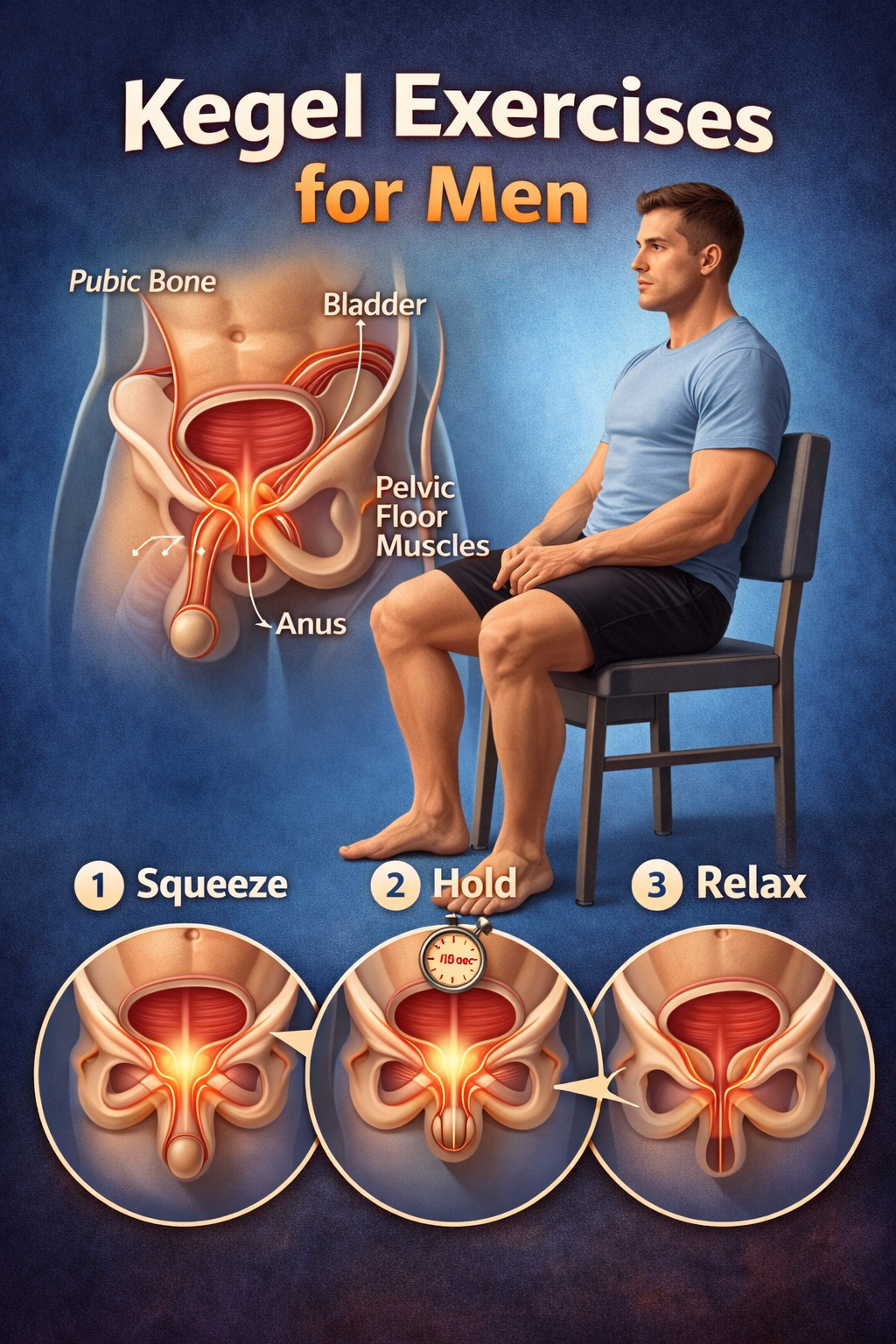
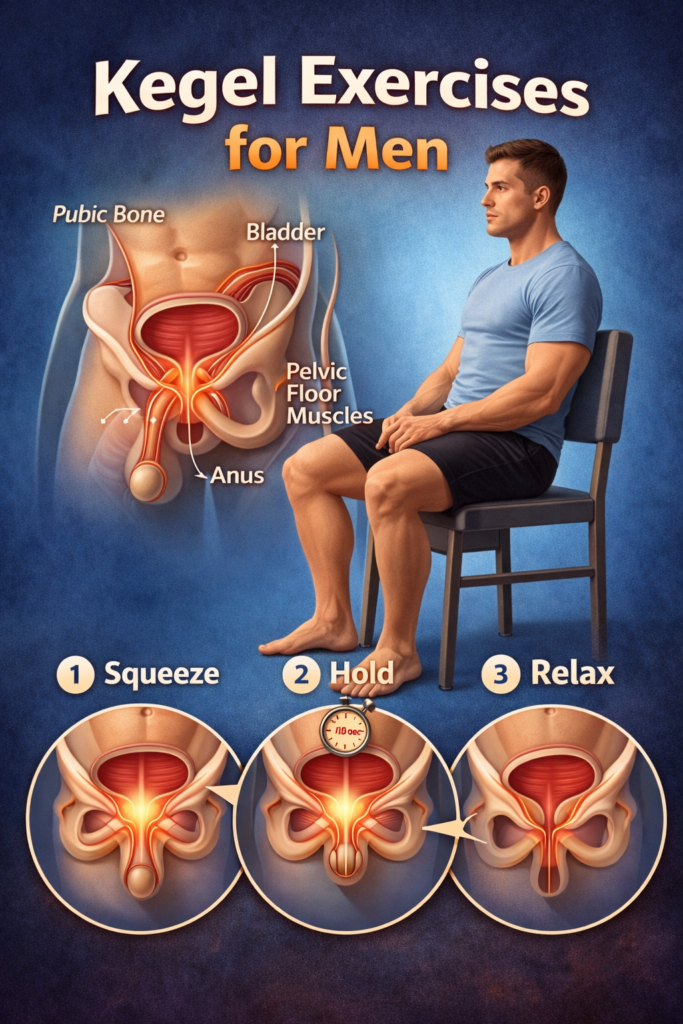
Understanding the Male Pelvic Floor
The pelvic floor isn’t a single muscle but a layered hammock of interconnected muscles that perform functions men rarely consider until something goes wrong.
The Key Muscles:
- Pubococcygeus (PC muscle): The primary muscle of the pelvic floor, running from the pubic bone to the tailbone
- Iliococcygeus: Forms the pelvic diaphragm’s central portion
- Ischiococcygeus: Supports the pelvic organs from behind
- Bulbospongiosus: Surrounds the base of the penis and plays roles in erection and ejaculation
What These Muscles Actually Do
The male pelvic floor serves three critical functions:
Support: These muscles hold the bladder, rectum, and prostate in proper position, preventing pelvic organ prolapse (more common in women but possible in men after certain surgeries).
Sphincter Control: The pelvic floor works with urinary and anal sphincters to maintain continence. When you urgently need a bathroom, it’s your pelvic floor holding the line.
Sexual Function: The bulbospongiosus muscle contracts rhythmically during ejaculation, propelling semen. It also contributes to erection by compressing veins that would otherwise allow blood to drain from the penis.
The Aging Factor
Unlike biceps or quadriceps, men rarely consciously exercise their pelvic floor. Consequently, these muscles follow a predictable decline:
- 30s: Subtle weakening begins, often unnoticed
- 40s: First signs of urinary urgency or minor leakage may appear
- 50s: Prostate changes compound pelvic floor challenges
- 60s and beyond: Significant dysfunction becomes common, affecting quality of life
The good news: like any skeletal muscle, the pelvic floor responds to targeted exercise at any age.
Part Two: The Evidence Base—What Science Actually Shows
Urinary Incontinence: The Strongest Evidence
The most thoroughly researched benefit of Kegel exercises for men is urinary incontinence management. A 2019 systematic review and meta-analysis published in European Urology examined 31 randomized controlled trials involving over 2,500 men. The conclusion was unambiguous: pelvic floor muscle training significantly reduced urinary incontinence episodes compared to no treatment .
Post-Prostatectomy Incontinence: Prostate cancer surgery (radical prostatectomy) inevitably affects urinary control temporarily, and sometimes permanently. Research demonstrates that men who perform Kegel exercises both before and after surgery regain continence faster and more completely than those who don’t. A 2020 study found that preoperative pelvic floor training reduced post-surgical incontinence duration by an average of 3-4 months .
Stress Urinary Incontinence: Leakage with coughing, sneezing, laughing, or lifting affects men more commonly than recognized. Kegel exercises strengthen the sphincter mechanism, providing better closure pressure during intra-abdominal pressure spikes.
Erectile Function: Promising but Nuanced
The relationship between pelvic floor strength and erectile function has gained increasing research attention. The bulbospongiosus and ischiocavernosus muscles actively compress the penile veins during erection, reducing venous outflow and maintaining rigidity.
A 2018 randomized trial published in The Journal of Sexual Medicine compared pelvic floor rehabilitation to no treatment in men with erectile dysfunction. After three months, the exercise group demonstrated significant improvements in erectile function scores, with 40% reporting return to normal function compared to 11% in the control group .
The mechanism appears twofold: improved muscular trapping of blood and enhanced neural signaling through the pudendal nerve, which runs through the pelvic floor.
Premature Ejaculation: The Control Factor
Premature ejaculation affects approximately 30% of men at some point. Kegel exercises address this through voluntary muscular control. The same muscles that contract rhythmically during ejaculation can be consciously relaxed to delay climax.
A 2015 study in Arab Journal of Urology found that men with premature ejaculation who performed daily Kegel exercises for 12 weeks increased their intravaginal ejaculatory latency time from an average of 42 seconds to over 3 minutes—a clinically and personally significant improvement .
Chronic Pelvic Pain: The Relaxation Paradox
Interestingly, while Kegels typically involve contraction, the exercises also teach awareness that enables relaxation. Many men with chronic pelvic pain actually have hypertonic (overly tight) pelvic floors. For these individuals, the “reverse Kegel”—conscious relaxation—provides more benefit than contraction. Learning pelvic floor awareness through Kegel practice helps men identify and release chronic tension.
Part Three: Finding the Muscles—The Critical First Step
The Common Mistake
Most men attempting Kegel exercises for the first time recruit the wrong muscles. They hold their breath, tighten their buttocks, clench their thighs, or bear down as if having a bowel movement. All of these mistakes render the exercise ineffective and sometimes counterproductive.
Three Reliable Techniques for Finding Your Pelvic Floor
Technique One: The Stop-Stream Method
The most common instruction involves stopping urination midstream. When you successfully interrupt the flow, you’ve contracted your pelvic floor.
Important Caveat: This is a finding technique, not an exercise technique. Performing Kegels during urination regularly can disrupt bladder emptying and increase infection risk. Use this method once or twice to identify the muscles, then practice separately.
Technique Two: The Mirror Check
Stand without clothing in front of a mirror. Contract as if preventing urination. If performed correctly, you should observe:
- The base of the penis pulls slightly inward
- The testicles may elevate slightly
- No visible tightening of buttocks or thigh muscles
Technique Three: The Finger Palpation (Optional)
With clean hands and trimmed nails, gently place a finger against the perineum (the space between scrotum and anus). A correct contraction creates a lifting sensation against your finger. This method provides direct feedback but requires comfort with self-examination.
The Visualization Approach
For many men, imagining specific actions helps recruit the correct muscles:
- Imagine stopping yourself from passing gas while tightening the anal sphincter
- Visualize lifting the entire pelvic floor upward, as if drawing the testicles toward the abdomen
- Picture a elevator rising from the basement (relaxed) to the first floor (slight contraction), second floor (moderate contraction), and third floor (maximum contraction)
Part Four: The Technique—Doing It Right
The Basic Kegel: Step by Step
Step 1: Empty Your Bladder
A full bladder increases urgency and makes proper contraction difficult. Empty before each session.
Step 2: Find Your Position
Beginners should start lying on their back with knees bent, feet flat on the floor. This position relaxes abdominal and gluteal muscles, isolating the pelvic floor. As you progress, sitting and standing become valuable positions.
Step 3: Breathe Correctly
Inhale deeply through your nose, allowing your abdomen to expand. Exhale slowly through your mouth as you perform the contraction. Never hold your breath during Kegel exercises—this increases intra-abdominal pressure, working against your goals.
Step 4: Contract
Squeeze your pelvic floor muscles as identified earlier. The sensation should be one of lifting and squeezing, not bearing down. Aim for a moderate contraction—about 60-70% of maximum effort—rather than straining.
Step 5: Hold
Maintain the contraction for 3-5 seconds initially. As strength improves, work toward 10-second holds. The muscle should remain contracted throughout; if it fatigues and releases early, reduce the hold duration.
Step 6: Relax Completely
Full relaxation between contractions is as important as the contraction itself. Consciously release all tension for an equal or longer period (5-10 seconds). This relaxation phase prevents muscle fatigue and teaches the important skill of pelvic floor release.
Step 7: Repeat
Aim for 10-15 repetitions per session.
The Speed Variation
Beyond sustained holds, incorporate quick contractions:
Quick Flicks: Contract and release rapidly, as if stopping and starting urine flow repeatedly. These target fast-twitch muscle fibers important for cough-induced continence and ejaculatory control.
The Routine: Combine both types—10 sustained holds followed by 10-20 quick contractions.
The Reverse Kegel
For men with pelvic pain, urinary hesitancy, or difficulty relaxing:
The Technique: After a normal exhalation, consciously and gently push downward and outward as if trying to pass gas or urine, but without straining. The sensation should be one of lengthening and releasing the pelvic floor.
When to Use: Reverse Kegels prove particularly valuable between contraction sets and as a standalone practice for men with hypertonic pelvic floors.
Part Five: The Program—Building Strength Systematically
Frequency and Duration
The evidence supports daily practice, but quality matters more than quantity. An effective program:
Weeks 1-2: One daily session, lying position, 3-second holds, 10 repetitions
Weeks 3-4: Two daily sessions, sitting and lying positions, 5-second holds, 15 repetitions
Weeks 5-8: Two daily sessions, standing and sitting positions, 10-second holds, 15 repetitions, plus 20 quick contractions
Week 9 onward: Maintenance—one daily session, varied positions, 10-second holds and quick contractions
The Three-Month Rule
Pelvic floor muscles, like any muscles, require consistent training for visible results. Most men notice improvements within 4-6 weeks, but significant functional changes typically require 3 months of consistent practice. The neuromuscular adaptation—teaching your brain to recruit these muscles automatically during daily activities—takes time.
Integrating Into Daily Life
The beauty of Kegel exercises lies in their discretion. No equipment, no special clothing, no noticeable movement. Integrate them into existing routines:
- During your morning shower
- While brushing teeth
- At red lights while driving
- During television commercials
- While waiting for coffee to brew
This habit-stacking approach ensures consistency without requiring additional “exercise time.”
Part Six: The Knack—Functional Application
Beyond structured exercise sessions, the “Knack” technique applies Kegel principles to real-time situations.
What Is the Knack?
The Knack involves consciously contracting your pelvic floor immediately before and during activities that increase abdominal pressure. This pre-emptive contraction provides additional support precisely when needed.
When to Use the Knack
Coughing or Sneezing: Contract firmly just before and throughout
Lifting: Contract before lifting and maintain during the effort
Laughing: Quick, repeated contractions during laughter
Standing from sitting: Contract as you rise
Sexual activity: Strategic contractions during arousal and before ejaculation
The Knack transforms Kegel exercises from isolated practice into functional, protective behavior.
Part Seven: Common Mistakes and Problem-Solving
Mistake One: The Breath Holder
The Problem: Holding breath during contractions increases intra-abdominal pressure, pushing down on the pelvic floor rather than lifting it.
The Solution: Practice breathing while contracting. Inhale, exhale as you contract, inhale as you relax. Record yourself or practice in front of a mirror watching your chest and abdomen.
Mistake Two: The Buttock Clencher
The Problem: Tightening glutes masks ineffective pelvic floor contraction and can cause lower back pain.
The Solution: Place hands on buttocks during practice. If you feel movement beneath your hands, relax and refocus on the deeper pelvic muscles.
Mistake Three: The Bearing Down
The Problem: Pushing down rather than lifting up—essentially performing the opposite of the intended movement.
The Solution: Focus on the “lift” sensation. Visualize drawing the testicles upward. Practice reverse Kegels first to understand relaxation, then build contraction from that baseline.
Mistake Four: Overtraining
The Problem: More isn’t better. Overtraining leads to muscle fatigue, paradoxical weakness, and sometimes pelvic pain.
The Solution: Respect the rest periods. Two quality sessions daily outperform five rushed, fatigued sessions. If you experience pelvic discomfort, take a rest day and reduce intensity.
Part Eight: Special Populations and Considerations
Post-Prostate Surgery Patients
Men scheduled for prostate surgery should begin Kegel exercises at least 4-6 weeks preoperatively. This preoperative conditioning creates muscle memory and baseline strength that significantly accelerates post-surgical recovery.
After surgery, resume gentle contractions once the catheter is removed, typically starting with very gentle, brief holds. Gradually progress as comfort allows. Most men require 3-6 months of consistent practice for optimal continence recovery.
Men with Overactive Bladder
Kegel exercises complement bladder training for urgency and frequency. The mechanism involves using pelvic floor contraction to inhibit detrusor muscle contractions (the bladder muscle that creates urgency). When urgency strikes, perform several quick, firm contractions while breathing calmly, and the sensation often subsides, allowing controlled voiding rather than rushed urgency.
Men with Chronic Constipation
Pelvic floor dysfunction often contributes to constipation, and constipation weakens the pelvic floor—a vicious cycle. Kegel exercises strengthen the muscles involved in defecation coordination, but must be combined with adequate fiber, hydration, and proper toileting posture (knees above hips) for optimal results.
Part Nine: When Exercise Isn’t Enough—Seeking Help
Red Flags
While Kegel exercises benefit most men, certain symptoms warrant professional evaluation before self-treatment:
- Blood in urine or stool
- Painful urination or ejaculation
- Complete inability to urinate
- Sudden onset of incontinence without identifiable cause
- Pelvic pain unresponsive to gentle exercise
The Pelvic Floor Physical Therapist
A specialized pelvic floor physical therapist represents an underutilized resource. These professionals provide:
- Biofeedback devices showing muscle activity in real time
- Manual therapy for tight or tender muscles
- Electrical stimulation for weak or unresponsive muscles
- Personalized programs addressing specific dysfunctions
For men with persistent symptoms despite 3-4 months of consistent home exercise, pelvic floor physical therapy offers the next level of care.
Part Ten: Beyond Kegels—Supporting Pelvic Health
The Bigger Picture
Kegel exercises don’t exist in isolation. Optimal pelvic health requires:
Proper Bowel Habits: Avoid straining, respond promptly to urges, maintain fiber intake.
Healthy Weight: Excess abdominal weight increases intra-abdominal pressure, chronically stressing the pelvic floor.
Appropriate Exercise: High-impact activities strengthen the pelvic floor when properly performed but can weaken it when form breaks down. Core exercises should emphasize the transverse abdominis, which works synergistically with the pelvic floor.
Hydration: Concentrated urine irritates the bladder, increasing urgency and frequency. Adequate water intake supports bladder health and pelvic comfort.
Conclusion: The Foundation You Never Knew You Needed
The pelvic floor occupies a unique position in male anatomy—invisible, rarely discussed, yet fundamental to functions men care about most. Urinary control, sexual performance, and pelvic comfort all depend on these unsung muscles.
Kegel exercises offer something rare in health: a zero-cost, zero-equipment, evidence-based intervention with minimal risk and potentially transformative benefits. They require only knowledge, consistency, and perhaps five minutes daily.
The men who benefit most aren’t those with existing dysfunction, necessarily. They’re the men who recognize pelvic floor training as preventive maintenance—investing in future function before problems emerge. Like brushing teeth or wearing seatbelts, Kegel exercises represent simple behaviors with profound long-term returns.
Start today. Find the muscles. Practice consistently. And build the foundation that supports everything else.
This article is for informational purposes only and does not constitute medical advice. Always consult healthcare providers before beginning new exercise protocols, especially if you have existing medical conditions or symptoms.